According to the Wall Street Journal and citing data from the Centre for Global Development, there is an 85% probability that a safe and effective vaccine will be approved by the end of the year. Once the vaccine is approved by the regulator, the next key challenge is to deploy the vaccine everywhere and that may not happen until September 2023.
For the meantime, the Covid-19 crisis rages on. With interest rates near zero, investors are increasingly searching the fixed income universe for securities that generate a steady source of income. Rates are likely to remain low for an extended period of time and that could drive investment capital into higher yielding sections of the market. Eventually, the appetite for perpetual securities will return but capital allocators will likely stick to companies with strong fundamentals while avoiding those that have undergone a more permanent structural change.
One area that is not going away soon is retail activity. When lockdown measures were lifted in Singapore and Australia, consumers immediately thronged shopping malls as virus cases began to fall. The rebound in shopper traffic demonstrated that there was a large pent-up demand for shopping in physical stores.
Extending our perspective beyond 2021, demand for data hosting, aged care and student housing will improve and these developments will benefit Singapore Press Holdings Limited (“SPH”; Bloomberg ticker: SPH:SP). The publishing conglomerate has invested heavily in these sectors. To fund these acquisitions, it raised S$450m through perpetual notes in 2019 and S$500m via a ten-year bond offering early this year.
About SPH
Listed on the main board of the Singapore Exchange, SPH is a leading media organization and property company. Incorporated in 1984, SPH is regulated under the Newspaper and Printing Presses Act (Chapter 206). As specified by the laws in the Act, a number of restrictions apply in respect to the control and voting powers of newspaper companies. For example, no person shall become a substantial shareholder of a newspaper company without obtaining the approval of the Minister.
Under the terms of the Act, the publisher is obligated to issue two classes of shares – management shares and ordinary shares. Management and ordinary shares rank pari passu in relation to dividends and bonuses, together with rights of participation in all surplus assets of the firm in liquidation. In terms of voting rights, holders of management shares are entitled to 200 votes for each management share held, on any resolution relating to the appointment or dismissal of a director or any member of the staff of SPH.
As of 31 Aug 19, these management shares constitute a small percentage of paid-up capital. The five largest owners of management shares were The Great Eastern Life Assurance Company Limited (22.6%), Oversea-Chinese Banking Corporation Limited (16.8%), NTUC Income Insurance Cooperative Limited (16.35%), Singapore Telecommunications Limited (13.3%) and DBS Bank Ltd (9.5%).
SPH recognizes revenue from three main operating segments – media, property and others. The media segment is responsible for the production of content for the distribution on print and other media platforms. Income from the management, development and holding of properties in the retail, student accommodation and residential sectors are recorded in the property segment.
All other business units that are currently not significant individually are reported under “others”. These include the group’s operations and investments in online classifieds, aged care, events and exhibitions, education, New Media Fund and treasury and investment.
Media segment
SPH is the sole provider of all print newspapers in Singapore including The Straits Times and Lianhe Zaobao. With a daily average circulation of close to 450,000, The Straits Times is the most-read English newspaper in the country with a 175-year operating history. The flagship Chinese newspaper, Lianhe Zaobao, has been in print for 97 years and has a daily average circulation of nearly 140,000.
Apart from traditional print media like newspapers, SPH also runs a magazine business. SPH Magazines Pte Ltd, a wholly-owned subsidiary, publishes and produces magazine titles covering various topics from lifestyle to information technology.
Like many other publishers, SPH has expanded its effort to reach more online readers and audiences. The group has seen an increased take-up of its all-digital subscription plans and e-paper editions of its newspapers.
Additionally, the group is invested in various digital ventures to supplement income from existing print businesses. SgCarMart, for one, has supported SPH’s existing offline classified listings for cars. Other investments include stakes in SRX, an online property search portal that helps to propel the company’s print classifieds business.
Separate from its printing and publishing arms, SPH also runs a radio broadcasting business. SPH Radio Pte Ltd manages the company’s five stations – MONEY FM 89.3, ONE FM 91.3, Kiss92, UFM100.3 and 96.3 Hao FM. In addition, SPH is involved in outdoor advertising as it maintains a network of marketing billboards in the Central Business District and Orchard Road via SPHMBO.
Property segment
The group’s property portfolio is largely centred around SPH REIT, a real estate investment trust and 70%-owned subsidiary. According to its recent filing, SPH REIT manages a portfolio of five retail properties with an average portfolio occupancy of 97.7%.
In Singapore, SPH REIT owns The Rail Mall (valuation as at the end of August: S$62.2m), Paragon (S$2,640m) and The Clementi Mall (S$584.0m). Down under in Australia, SPH REIT manages operations at the Westfield Marion Shopping Centre (AUD 646.5m) in Adelaide and Figtree Grove Shopping Centre (AUD 190.0m) in New South Wales.
During the fiscal year ending 31 Aug 20 (“FY2020”), SPH REIT’s portfolio occupancy stayed high at 97.7% in the face of a virus outbreak. Net property income increased 1.2% YoY from S$179.8m to S$181.9m, although distribution income fell 36.4% YoY to S$92.2m. SPH REIT is listed on the Singapore exchange and the trust recorded a market capitalization of S$2.45 billion on 6 Oct 20. There are S$225m of credit facilities available to the REIT that may be utilized when required.
Amongst other assets within the group’s real estate portfolio, SPH owns The Seletar Mall. The group is also constructing an integrated development consisting of The Woodleigh Residences and The Woodleigh Mall. At the end of FY2019, The Seletar Mall was recorded as part of investment properties, while the Woodleigh mixed development was accounted as a joint venture. Based on a valuation assessment by Colliers International, Seletar Mall was valued at S$480m as at 31 Aug 20.
PBSA
SPH is one of the leading players in the purpose-built student accommodation (“PBSA”) market in the UK and Germany. After the acquisition of seven assets in the UK last December, SPH’s portfolio expanded to 7,723 beds across 28 assets in the UK and Germany, bringing overall PBSA assets under management to S$1.4 billion.
Aged care
SPH receives income from its properties in the aged care sector. In 2017, the company acquired Orange Valley Nursing Homes for S$164m. Earlier this year, the group completed the purchase of five senior independent living assets in Japan for JPY 5.26 billion (~S$67.8m). The aged care facilities in Japan have long-term master lease arrangements with existing tenants, with a portfolio WALE of 23.4 years (weighted by bed count) and weighted average age of 3.5 years (weighted by bed count).
Other businesses and associates
In the exhibition industry, SPH organizes events through Sphere Exhibits Pte Ltd, a subsidiary that focuses on management of consumer events and trade exhibitions. SPH also invested in a number of companies that are recognized as associates on the balance sheet. These include ownership stakes in Konnectivity Pte Ltd (FY2019: 20%), MindChamps Preschool Limited (FY2019: 20%) and KBS US Prime Property Management Pte Ltd (FY2019: 20%).
Konnectivity runs M1, one of the three major telecommunications service providers in Singapore. Lately, M1 was awarded the license to roll out the 5G network in Singapore by the Infocomm Media Development Authority.
KBS US Prime Property Management Pte Ltd manages Prime US REIT, a listed entity on the Singapore exchange with a market cap of S$903.6m on 14 Oct 20. MindChamps is also a Singapore-listed company with a market cap of S$65.6m.
Data management venture
In June this year, Keppel Corporation Limited and SPH announced that the companies would incorporate a joint venture firm, Memphis 1 Pte Ltd, for the development, operation, maintenance and management of data centre facilities at 82 Genting Lane, Singapore. Keppel Corp would own 60% of the joint venture, while SPH would have a 40% interest.
Under the agreement between the parties, Keppel Corp would contribute a maximum of S$209.0m to the joint venture, while contributions from SPH would be capped at around S$139.6m. The purchase consideration of S$50m for the leasehold interest in 82 Genting Lane would be paid to Singapore News and Publications Limited, a wholly-owned subsidiary of SPH.
Financial performance
SPH’s operating revenue dropped 9.8% to S$865.6m in FY2020 from S$959.3m a year ago. Media revenue dropped 22.8% YoY to S$445.1m, while operating revenue from property and Others increased 10.3% and 8.7% to S$327.2m and S$93.3m respectively.
Majority of the group’s property income comes from SPH REIT, which recorded gross revenue of S$241.5m in FY2020, with the PBSA portfolio growing its top line to S$58.6m. Under the Others segment, SPH’s aged care business increased revenue by S$26.3m.
Weaker results in the media segment were driven by lower advertisement sales, as newspaper print ad and digital ad revenues dropped 32.9% YoY and 6.2% YoY respectively. In spite of the drop in media revenue, daily average newspaper circulations remained at the same level during FY2020.
Figure 1: Total digital revenue since FY2017
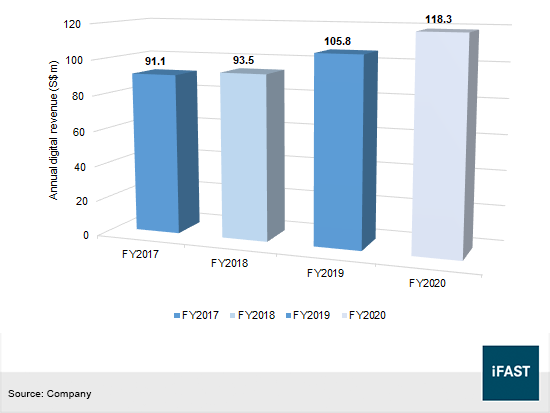
One notable exception, however, was an improvement in average circulations of The Straits Times and this was underpinned by a 66% growth in digital circulations. As a whole, total digital revenue (Figure 1) expanded at a 9.1% compound annual growth rate from S$91.1m to S$118.3m since FY2017.
Figure 2: Operating revenue by segment
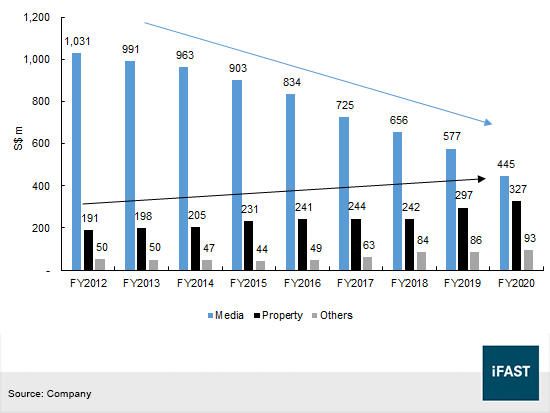
Media revenue has declined since FY2012, while revenue from the property segment continued to advance over the same period (Figure 2). If this trend continues, income from properties could exceed the media segment by FY2022.
A turnaround for media is yet to be seen, but there is growing voice in the community that is calling for regulatory changes to address the decline in local journalism in various parts of the globe. In July, the Australian government asked Google and Facebook to pay news outlets for using their content. Negotiations between the parties are underway but if technology companies have to pay for news content that is distributed on their platforms, it could create an added source of income for content owners and this would be advantageous to SPH.
Media sales could also turn around if the newspaper company raise prices for its publication. Most other foreign publications like The Guardian or Sydney Morning Herald cost nearly twice the amount of a copy of The Straits Times, so it would not be surprising to see an increase in newspaper prices.
SPH made an operating profit of S$110.2m, down 41% from FY2019. Finance costs increased by S$15.8m, from S$49.3m in FY2019 to S$65.1m in FY2020, mainly due to interest costs on the recently issued S$500m notes due 2030 and loan facilities taken up to fund the acquisition of new assets in the PBSA portfolio and Westfield Marion. After accounting for other non-recurring items, including a fair value investment property charge of S$232.0m, SPH registered its first annual net loss of S$112.5m in FY2020.
However, operating cash flows stayed positive for the year. Cash flows before changes in working capital decreased to S$259.3m in FY2020 from S$300.7m in FY2019. Concurrently, net cash from operating activities dropped slightly from S$237.5m to S$221.3m
Credit and liquidity considerations
Cash and cash equivalents increased to S$864.7m, supported by operating cash flow, and net cash from financing activities exceeded net cash used in investing activities. Cash was, however, lower than the level of current borrowings of S$1,286.0m.
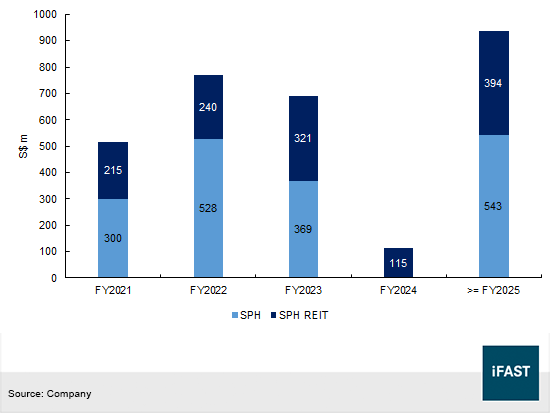
SPH continued to be in a net current liability position, but the group intends to refinance the S$300 million and S$215 million loans taken up by The Seletar Mall Pte Ltd and SPH REIT respectively, upon maturity in FY2021. According to the group, there are different options for financing these loan amounts, and it has sufficient unutilised credit facilities and marketable securities available for use. We are thus comfortable with SPH’s near-term debt maturities.
Total group borrowings added to S$3.48 billion in FY2020, out of which S$2.01 billion were secured debt. Secured borrowings were made up of S$995m for SPH REIT, S$300m for The Seletar Mall Pte Ltd, GBP 205m for Straits Capitol Trust, AUD 105m for Figtree Holding Trust, AUD 200m for Marion Sub Trust and JPY 3.2 billion for Straits Himawari TMK One TMK and Straits Himawari TMK Two TMK.
If required, we think SPH has other measures available to raise liquidity, like monetizing its assets. These would include some of the hard assets in its investment property portfolio (valued at S$6.42 billion), its investment in associates (carrying value of S$358.1m), along with S$423.6m of investments (of which S$180.4m were unquoted investments measured at Level 3 of the fair value hierarchy).
Based on the term debt maturity profile in Figure 3, there are S$515m of term borrowings due in FY2021 and S$768m due in FY2022. According to SPH, the weighted average debt to maturity is 3.4 years. Interest coverage ratio was reported to be 3.8x as of end-August, down from 5.2x in February.
Figure 3: Term debt maturity profile
However, our measure of interest-servicing ability is somewhat more conservative. Taking the negative fair value change on investment properties into consideration, we estimated earnings before interest and tax expenses (“EBIT”) at S$347.6m in FY2019 and negative S$20.2m in FY2020. Adjusting for the fair value change on investment properties, adjusted EBIT would have been S$211.8m for the latest fiscal year.
Group EBIT over interest expense was reasonably comfortable at ~2.5x, assuming interest expense of S$83.9m for servicing perpetual securities and borrowings. EBIT over interest would fall to ~2.1x if we include payments for lease liabilities as part of interest costs.
On the gearing front, we note that borrowings and perpetual securities, when expressed as a percentage of total assets, were 44.4% in FY2020. Excluding perpetual notes from this gearing measure, the debt-to-asset ratio would be 39.3%.
We view SPH’s gearing as roughly in line with a sample group of Singapore real estate firms we track. As a reference, Frasers Property Limited had a debt-to-asset ratio of 56.2% at the end of March (including perpetual securities and lease abilities). Meanwhile, Wing Tai Holdings registered debt over assets of 23.3% at the end of June.
Recommendation
We compared the indicative yields to maturity (“YTM”) and yields to next call (“YTC”) of comparable SGD issues within the real estate and communications sectors, and found the SPHSP 4.500% Perpetual Corp (SGD) attractively priced (Figure 4) at its indicative ask price of 100.9 (YTC: 4.22%) as at Oct 14. Using forward swap rates as at Oct 14, we estimated the indicative YTCs for the SPHSP 4.5% perps in Table 1.
The SPHSP 4.5% perps are callable at par on 7 Jun 24 and every six months thereafter. If SPH does not redeem the note on the first call date, the coupon rate would reset to the sum of the prevailing five-year SGD swap offer rate, the initial spread of 261.2 basis points (“bps”) and a step-up margin of 100 bps. Other terms and conditions of the SPHSP 4.5% perps include a cessation put, dividend stopper and dividend pusher with a six-month look-back period.
Table 1: Yields to call for the SPHSP 4.5% perps assuming different call dates
|
07 Jun 24 |
07 Dec 24 |
07 Jun 25 |
|
4.22% |
4.27% |
4.31% |
| Source: Bloomberg Finance L.P., iFAST compilations. Note: Yields are based on indicative ask price of 100.9 and SGD swap rates on 14 Oct 20. | ||
Figure 4: Relative Valuation
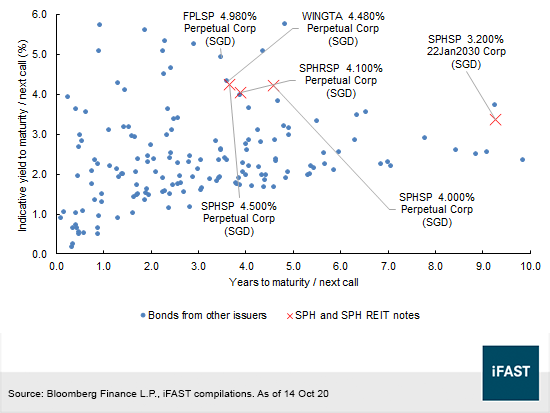
Going beyond the five-year tenors, the SPHSP 3.200% 22Jan2030 Corp (SGD), which is the only SPH bond of fixed maturity, is presently trading at a discount at 98.4, perhaps reflecting recent weakening in issuer credit quality due to Covid-19. The SPHSP 3.2% ‘30s were issued before the virus escalated into a global pandemic.
Looking at other SGD perpetual notes that are callable in 2024, we observed that the FPLSP 4.980% Perpetual Corp (SGD) and WINGTA 4.480% Perpetual Corp (SGD) were priced at YTCs of 4.91% and 4.33% respectively. On this note, we think the lower YTC of the SPHSP 4.5% is justified given SPH’s overall healthier credit profile.
On the other hand, the difference between the SPH 4.5% perps and WINGTA 4.48% perps is more subtle in our view. Wing Tai Holdings has a lower gearing ratio and the WINGTA 4.48% perps have a slightly higher yield to call. Having said that, Wing Tai Holdings has a significantly smaller operating scale and a less diversified business profile.
Figure 5: Credit spreads
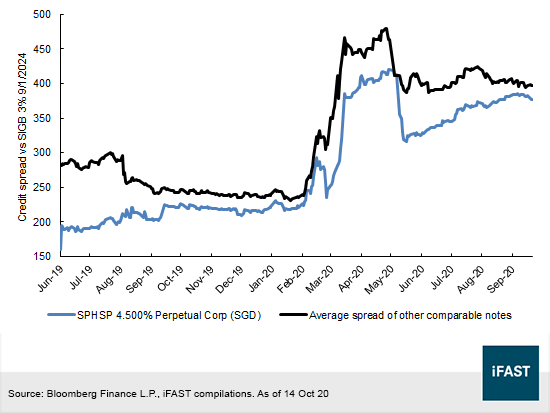
Credit spreads, measured as the difference in YTC over the 3% Singapore Government Securities due 2024, indicate that the SPHSP 4.5% perps traded historically at a wider spread differential, relative to the average of comparable notes (Figure 5), than current levels (i.e. the SPHSP 4.5% perps have become cheaper on a relative basis). G-spreads of the SPHSP 4.5% perps soared to nearly 475 bps in May, although they have since narrowed to 396 bps on 14 Oct 20.
In summary
SPH enjoys a strong position in the domestic newspaper market and the group has enlarged its portfolio of PBSA and aged care properties overseas. Demand for PBSA is projected to climb as the growth rate of the UK’s student population is expected to be 2% per annum between 2020 and 2030, based on a forecast by the UK Office for National Statistics. Asian societies are also set to become more affluent over time and more students may opt to pursue their education in the UK.
Aged care is another potential growth pillar for SPH as the percentage of elderly in Japan is estimated to reach 30% by 2025. In Singapore, demographic trends from the Department of Statistics showed that the number of persons aged 65 years and older could nearly double to 900,000 by 2030 from 548,000 in 2018.
To diversify its exposure from the media business, SPH is venturing into the management of data centers, which could yet create another driver of growth for the company. The media and real estate firm is already focusing on digital innovations and this has resulted in improved user adoption of its online media platforms. Taking into account its content rights, award-winning journalism and increasing limitations on third-party cookies, we believe that advertisement revenue could pick up in future as more advertisers would likely turn to publishers like SPH that own first-party user data. After all, SPH has access to a large subscriber base and has been investing in its data collection, processing and activation capabilities for the past few years.
Because of its recent acquisition spree, capital expenditure levels have been high, although the group has taken cost-cutting steps to address the impact of Covid-19. We do not foresee significant difficulty from SPH in meeting its current debt obligations, given the group’s track record in terms of access to capital markets, S$864.7m cash position and credit facilities available for use.
In a statement to the press in February, SPH floated the possibility of a public listing of its PBSA arm. A public offering through a real estate investment trust vehicle would lift its liquidity profile significantly as the PBSA assets are valued at more than USD 1 billion as of end-August.
Considering the above factors, we recommend investing in the SPHSP 4.5% perpetual bond at its YTC of 4.20%. This is presently one of the higher yielding notes in the SGD space. Not only does SPH have a decent credit profile, it also has various liquidity options and a strong investment portfolio to support its future growth.
Declaration:
For specific disclosure, at the time of publication of this report, IFPL (via its connected and associated entities) has a principal position in FPLSP 4.980% Perpetual Corp (SGD) and SPHSP 4.500% Perpetual Corp (SGD). The analyst who produced this report holds a NIL position in the abovementioned securities. SPH is a substantial shareholder of iFAST Corporation Ltd (parent of IFPL), holding 15.06% shareholding (as at 13 Mar 20) through its wholly-owned subsidiary, SPH Invest Ltd.
Our podcast series, Yield Hunters, is available on Spotify and iTunes Podcasts and Google Podcasts. We share our thoughts on new bond issues and hold discussions on the fixed income space. Listen to our latest episode below and follow us!